All posts by feedwordpress

The burden Canadian Copyright law is placing on higher ed institutions

I attended the annual BCNet conference in Vancouver yesterday where I was presenting on the BC Open Textbook Project (my slides).

While I was there I sat in on a session title the Copyright Modernization Act presented by Larry Carson, Associate Director, Information Security Management (UBC), Eric van Wiltenburg, Manager, Information Security Office (UVic), Dave Kubert IT Security Officer (UNBC), and Michal Jaworski, Legal Counsel (UBC). The session focused on how higher ed institutions have been responding to a new clause in the Canadian copyright act that came into effect in January of this year, the “Notice and Notice” provision .

In essence, the notice and notice provision now gives copyright holders a mechanism to track down suspected copyright infringement by putting the onus on ISP’s and other intermediaries (like post-secondary institutions) to contact suspected copyright offenders. Barry Sookman has a nice, succinct post describing the new regulation.

The regime permits copyright owners to send notices to internet service providers and other internet intermediaries claiming infringement of copyright. The notices must be passed on by these service providers to their users. Because there are no regulations, the notices must be processed and passed on by the internet intermediaries without any fees payable by copyright owners.

As illustrated in the session, this new provision is putting a large burden onto the shoulders of institutions that now have to track and contact potential copyright offenders on their network.

All the institutions made it clear that the only information that copyright holders have to go on is an IP address. How the copyright holders are obtaining the potential infringing IP addresses is unclear to me, but it is happening. Which explains to me why this has become a security issue at most institutions since they are often the first point of contact when any odd IP related activity comes up.

Once the copyright holder contacts the institution with an IP address that they allege is being used to illegally download their material, the institution then has an obligation to match the IP with a person and send that person a notice saying…well, that is one of the first problems institutions are struggling with. What to actually say in their notice. Institutions are grappling with this. Is it simply a notice to the alleged offender that this activity has been noticed on the network, or does the notice go further and ask them to stop? Institutions are (rightly so) hesitant to become the police and be forced into a role where they then become the enforcers of the legislation.

This process is placing a huge administrative burden on institutions as they have been spending a large amount of time and resources dealing with these notices. One of the panel participants reported their institution was receiving up to 10 notices per day, with the others stating that they were dealing with hundreds of these notices each month. Hence the desire to come up with technical processes to automate the routine.

Specifically, the administrative burden looks like this.

First, when the institution receives a notice from a copyright holder, the notice may not come from the actual copyright holder, but instead from a third party contracted by the copyright holder to act on their behalf. So the first step for the institution is to try and figure out if the notice request they receive is, in fact, legitimate. And, early on when the regulation came into effect, there were many non-legitimate requests being sent to Canadians demanding that they pay a fine for alleged copyright infringement (and who knows how many Canadians actually did this when there was no need to). So, the first task is figuring out who is actually contacting them and whether they have the authority to act on behalf of the actual copyright holder.

Second, the institution then needs to match the IP address with a person to send the notice to. Not an easy task, especially if you are using NAT. Another time consuming task when you are dealing with hundreds of requests a month.

There is a big stick for institutions that don’t forward notices to an offending party. If an institution fails to forward a request, then the institution can be held liable for the alleged copyright infringement even if there is no further proof that copyright infringement has occurred. This put an incredible onus on the institution to comply with forwarding notices as it presumes their guilt that a copyright infringement has occurred, and makes the institution responsible for the presumed offense.

Finally (at the risk of burying the lede here, depending on what role you have at an institution), one of the more ridiculous aspects of the “notice and notice” system is that faculty and academic researchers have been receiving these notices for posting their own journal articles and published research online. Imagine posting your journal article on your institutional website (or, perhaps on an open course where you might want your students to have access to the research for teaching and learning purposes) and you receive a “notice” from your own institution saying that you have been reported as a potential copyright thief? I can’t imagine that is a good feeling. There seems to me to be a real risk that this type of notification from your own institution, regardless of how benign or moderate the wording may be, could lead to internal divisiveness between faculty and administration (a point that was touched on briefly in the session).

Now, there is always the new fair dealing clause that you could use in your defense. But the onus is then on you to defend your use of your own work in response to the notice. There again is a presumption of guilt for a perfectly legitimate use of the material (and if you are a faculty or researcher where this type of scenario has happened to you, I would love to hear whether this paragraph rings true to with your own experience).

Using technology to fix bad legislation, while understandable given the circumstances, does feel like a coping mechanism; one that is putting a large administrative cost onto the backs of the institutions. It forces them to act as an intermediary on hundreds of alleged infractions or else risk being fined over suspected infringements. The legislation also casts such a wide net that legitimate uses of copyright material are being tagged as malicious, forcing faculty and researchers to prove that their use is legitimate. All this not only sucks up time and resources, but puts the institution in the position of being the one to cast a cold copyright chill down the backs of its staff, students and faculty.

Week 17 In Review: The #oeglobal Edition

The view

The view for much of my week in Banff, Alberta, where I attended the annual Open Education Global conference sponsored by the Open Education Consortium. This was my first time at the conference and a very enjoyable, informative conference it was. Here are some of my personal memories of the conference.

While it was a global conference, there were many more people from our local network than I expected, which was fantastic. I had some great discussions with our colleagues from the Alberta OER project, Washington State and Oregon.

Notable sessions included a session from BC’s Kwantlen Polytechnic University where Salvador Ferraras and Thomas Carey outlined how open education fits in the institutions strategic plan. It was notable because here were two high level administrators from the institution articulating an institutional open policy that goes beyond OER and Open Access and attempts to embed open practices within the institution. Some very forward, strategic institutional thinking about open education happening at Kwantlen. I knew that Kwantlen was into open, but I don’t think I realized just how deeply it was being embedded in the culture there until I saw the presentation. The paper.

I also enjoyed the session from Paul Stacey on large scale national OER initiatives.  I’ve been struggling trying to do some big picture conceptualization and come up with a plan for system wide open initiatives. Paul’s framework was like manna as it provides a solid starting point for me to do both some big picture thinking, and articulate that big picture to a large system.

Mark Surman, Executive Director of the Mozilla Foundation, delivered the final day keynote and was fantastic (Stephen Downes blogged the keynote), talking about the threats to the open web and the increasing power and control that a handful of digital corporations (the Apple, Google, Facebooks of the world) have over our lives. I think Mozilla has done an excellent job of both grounding and articulating their learning model.  I’ve been loosely connected to Mozilla Webmaker initiatives here in Victoria for a few years, and have been watching with interest as Mozilla increases their informal learning activities around web literacy.  The thing that  connected a lot of dots with how Mozilla works (at least in their webmaker and teaching & learning efforts) was when Mark talked about his punk background. You can see that punk ethos reflected in both the D.I.Y. ethos of their webmaker initiatives, and the wider social and political anti-oligarchy perspective that influences Mozilla’s proactive work on open. Mark hit all the right notes for me, including a nod to both McLuhan and the other, often forgotten Canadian media theorist Harold Innis. 

Was honoured to have the BC Open Textbook project recognized with an award of excellence by the consortium. But the winning project that really impressed me was Tony Coughlan‘s CYP (Children and Youth Programs) project, which is a repository/referatory of  open resources for teachers and trainers working in that field. What is so fantastic is that Tony created it for about $30. $30! And he receives thousands of hits from around the world. This is such a wonderfully illustrative example of how powerful – and important – a simple, well curated, well targeted collection of open resources can be to educators. And it was done by one smart person using a WordPress site. For $30. We need more projects like this.

As always, people are the heart of any conference and this one was no different. I especially appreciated having some one on one time with David Wiley over lunch where we talked about the OpenEd conference in Vancouver this fall,and strengthening the relationship between what Lumen is doing and the work we are doing at BCcampus. One of the items we talked about was our shared use of PressBooks (which Lumen has rebranded as Candela for their purposes) and how we can work closer together in development. Dave Ernst from University of Minnesota was also there (and the open textbook network he has been working on that came out of his stint at the Institute for Open Leadership looks like it is taking off) , and the three of us discussed the possibilities of having some kind of PressBooks specific event, like a code sprint with our developers, around the open textbook summit in May. We have agreed that, to be effective, we need to find a project that benefits all three of us, and I have pitched the idea of extending the API’s that Brad has been working on to see if we can created this federated model of PB instances where we can each search and copy content from our respective instances into our own instances. Conceptually, Brad has done the groundwork to enable this and I think that if we can make this happen it would be a good win for all of us. But this is something that is still in the very nascent stages, and a few things have to fall in place before we can make this happen at the summit. A more likely timeline might be OpenEd in November. Where the three of us have agreed to work on immediately is sharing the load in getting existing open textbooks that are in the commons into PressBooks. We all have people who are on deck to work on converting existing open textbooks into Pressbooks, and it makes sense that we don’t duplicate our efforts. So, we are sharing lists and roadmaps on making this happen over the next 6 months or so, greatly increasing the number of titles we collectively have in the platform.

Also very much enjoyed spending some time watching hockey and hiking mountains with Martin Weller from the Open University & the OER Research Hub. We have been working with the Hub on a research project for the past year, but I’ve followed and admired Martin’s work virtually for many years (and if you haven’t yet read The Battle for Open, it is a wonderful read that encapsulates so many of the issues we in open education are grappling with at the moment), so to have the opportunity to spend some time hanging with Martin was wonderful after connecting in virtual spaces for all these years.

Also great to again see and hang out with Richard Sebastian from Virginia Community Colleges (heart of Z Degree land), Heather Ross from USask, Una Daly from CCCOER, Barb Illowsky (who brought a game that has been developed by their librarians to help spread the word about student textbook costs – very clever!), David Porter, Paul Stacey, Danielle Paradis (who did a bang up presentation on her Masters research), Irwin DeVries (busy videotaping a whole bunch of early open education advocates for a project he is doing with UVic’s Valerie Irvine), Rob and Bea from the Hub, and a whole host of others that, as soon as you start making a list like this, you inadvertently and unintentionally leave off as conference blur sets in.

Finally, really enjoyed meeting & spending some time with Marc Singer from Thomas Edison State College in New Jersey. Marc and I were seated next to each other on the 1 1/2 hour bus ride from Calgary to Banff, and Marc was the third of the hiking trio up Tunnel Mountain.

Tunnel Mountain Hike

Banff, you are much younger and have a more pronounced Australian accent that I remembered the last time I was there. And your crosswalks, while a cool idea to cross diagonally and all at once, did mess with my “only cross on green light” trained mind.

Walk/Don't Walk

Next week, off to BCNet in Vancouver.

Week 16 In Review

Presentations, Workshops, Courses

  • Working on upcoming BCNet presentation on (what else) open textbooks.
  • Met with Gill and Barbara about our Open Textbook Summit presentation on the Geography booksprint.
  • Submitted proposal for OpenEd15 this fall with Gill and Barbara to present on same topic (ok, not quite done this yet, but will beat today’s midnight submission deadline).
  • Co-facilitated a live webinar with David Porter and Paul Stacey (Creative Commons), part of a 12 day Open Education course I am co-facilitating with Commonwealth of Learning and BC Ministry of Education.
  • Prepped for a Monday webinar with Megan Beckett (Siyavula) for same course.

Projects

  • Finished up a testbank for the Noba Project (a great Psychology open resource). They co-sponsored the Psychology TestBank Sprint last summer that Rajiv put together. I’ve been working with Respondus to make LMS import packages of the question banks for them. They have been very patient with me waiting for these files as it was one of those projects that always seemed to get delayed by the tyranny of urgent. Was nice to be able to do something that was a bit edtechish.
  • We’re planning a revamp of the Open site this summer and I’ve started brainstorming some notes on things I’d like to see changed.
  • The night before the Open Textbook Summit, we’ve decided to hold a thank you event for authors and adapters who have worked on open textbook projects we have funded. Did some work on that event, although Amanda and Lauri are handling the bulk of the work.

Reading

  • The Portable Z: We’re Doing Five Blades by Richard Sebastian. Following on the success of the Z Degree at Tidewater Community College, the state of Virginia is going to be rolling out Z Degree programs at all 23 state colleges. This is really exciting stuff; entire programs with $0 textbook costs, scaling up to cover an entire statewide system.
  • Finding the Problems OER Solves Martin Weller. I tend to think of myself as a pragmatic dreamer (a recipe for cognitive dissonance if there ever was one) leaning a bit heavy on the pragmatic side. Which is why I appreciate Martin’s perspective so much. This pragmatism was also evident in a presentation of Martin’s that I watched this week on The Battler for Open (which I am three chapters into) when he responds to the criticism that, after 10 years OER’s haven’t disrupted education with “has it just been useful?
  • The Defining Characteristics of Emerging Technologies and Emerging Practices in Online Education Geroge Veletsianos. Looking forward to the new edition of the book.
  • I read some posts about the Microsoft/McGraw Hill partnership, but honestly I tuned out after I heard Powerpoint. I probably should care more since McGraw-Hill does a lot of openwashing in their press release “McGraw-Hill Education’s embrace of open learning.” Yeah, right. Embrace. Call me cynical, but I don’t think we’ll see a lot of openly licensed content come out of this arrangement.

Other stuff

  • Took some time with the rest of the open textbook team this week for a celebratory lunch.
  • Met with the Faculty Fellows this week. All are going to be busy at various events around the province in the coming months presenting and talking about open textbooks. We have also been going over the findings of the faculty survey we did earlier this year with the OER Research Hub. The findings will form the basis of their presentation at the Open Textbook Summit in May. We’ll also be releasing the results on the open.bccampus.ca website over the summer.
  • Got the new @bcopentext Twitter account up and running.
  • Annoying login problem popping up with Pressbooks Textbook since we changed the login path in an attempt to stem the brute force attack that shows no signs of waning. Basically, if you are in as an editor or author in multiple books on the platform, you are being forced to log in twice. It may be an inconvenience we have to live with on our local platform (others who install Pressbooks Textbooks won’t have this issue – it’s something specific to our instance as a result of the persistent attack we have on our servers). Times like these, I am so grateful to have the skills of seasoned network administrators to rely on. I’ve spent too much time in the six stages of grief throughout my WordPress loving life.
  • Attended a presentation at my kids school on Internet Safety for Parents by Darren Laur. I was dreading this presentation since it was pitched to our school PAC a few months ago thinking it would be full of fear mongering. It didn’t make me feel much better after Googling about the presentation and finding out that Darren puts on the persona of a white hat hacker and creeps kids social media profiles befriending them as a 16 year old girl prior to doing his school presentations. Ick. Instead I was pleasantly surprised to see Darren present a pretty balanced view of digital citizenship. He made it a point to stress to the 50 or so parents in the audience that “your kids are doing some amazing things” and being positive digital citizens. I wish there was just as much emphasis on the role that schools should be playing in helping to create those digital citizens (I am still appalled at the lack of digital literacy education in my kids school curriculum) rather than placing the entire load on many parents to cultivate digital citizens, but overall I thought the presentation was good and not as fear monger-ish as I had expected.

Next week: packing my hiking shoes and off to Banff for OE Global, followed by a few days in Vancouver for the annual BCNet conference.

What is open education?

Wordle of this blog post, from http://www.wordle.net

Wordle of this blog post, from http://www.wordle.net

I wrote the following narrative for a teaching award application, and someone has requested that I post it openly as well, as it may be useful to others. I’m happy to do so! (Update July 18, 2015: unfortunately, I didn’t get the award, but you can see my entire application for it in this post).

This was a section of the application where I describe the basics about what open education is. I then go on, after this, to talk about how I engage in open educational activities in my own work. I might post those sections here later, in separate posts.

If you want to learn more about open education, there is also a great ebook called The Open Education Handbook. David Wiley has created an open course on open education, here: https://learn.canvas.net/courses/4

And here is the open education course at the Open University in the UK that I took in 2013. My blog posts from that course are here.


What is open education?

Financial, legal, technological openness: open educational resources

What is open education? To start, it is useful to consider the various meanings the word “open” can have in “open education.” Hodgkinson-Williams and Gray (2009) give a useful overview of some of these meanings, including what they call “financial openness,” “legal openness,” “technological openness, and “social openness.”

A common understanding of “open” is “free,” as in free of cost, or what Hodgkinson-Williams and Gray (2009) call “financial openness.” This is the meaning one might immediately think of as associated with Massive, Open, Online Courses. These are courses that are available for anyone with a reliable internet connection to take, free of cost.[1] Financial openness is also exemplified when a teacher makes a set of lecture notes, essay topics, a video, an image, etc. available for others to use without a fee.

“Legal openness” refers to the degree to which teaching materials, student work, research and more are licensed to allow others to reuse, revise, and redistribute. Some MOOCs, for example, may only allow you to view materials, not download them to revise or share them with others.[2] The “Open Definition” by the Open Knowledge Foundation addresses this meaning of open directly: “Open means anyone can freely access, use, modify, and share for any purpose (subject, at most, to requirements that preserve provenance and openness)” (Open Knowledge Foundation, n.d.). David Wiley, in a widely-used definition of “open content,” lists similar requirements for openness, and labels them the “five R’s”:

  1. Retain – the right to make, own, and control copies of the content (e.g., download, duplicate, store, and manage)

  2. Reuse – the right to use the content in a wide range of ways (e.g., in a class, in a study group, on a website, in a video)

  3. Revise – the right to adapt, adjust, modify, or alter the content itself (e.g., translate the content into another language)

  4. Remix – the right to combine the original or revised content with other open content to create something new (e.g., incorporate the content into a mashup)

  5. Redistribute – the right to share copies of the original content, your revisions, or your remixes with others (e.g., give a copy of the content to a friend) (Wiley, n.d.)

Wiley argues that the more of these five activities that are allowed, the more “open” a work or set of materials is. How one alerts others to the possibility that they can use one’s work in such ways is through an open license, such as a Creative Commons license. [3] Giving one’s work an open license means that one retains copyright, but allows others to use, share, and sometimes also revise the work without asking permission each time.

Hodgkinson-Williams and Gray (2009) also discuss “technological openness,” which refers to the use of different sorts of software tools. Those that are open source are more open technologically than those that are not. In addition, tools that allow for easy editing by anyone, without having to purchase the software, are more open: thus, documents in Open Office or Google Documents are considered more open than those in Microsoft Word. Both David Wiley and “The Open Definition” also acknowledge the importance of technological openness: if a work can only be edited using tools that are very expensive, or that only run on certain platforms, or that require a high level of expertise, it is less open.

Open education is often discussed in terms of using or creating “open educational resources,” or OER—these combine financial, legal, and technological openness. According to the William and Flora Hewlett Foundation,

OER are teaching, learning, and research resources that reside in the public domain or have been released under an intellectual property license that permits their free use and re-purposing by others. Open educational resources include full courses, course materials, modules, textbooks, streaming videos, tests, software, and any other tools, materials, or techniques used to support access to knowledge (William and Flora Hewlett Foundation, n.d.).

Thus, syllabi, lecture notes, video recordings of lectures, slides, animations, assignments, podcasts, and more can be OER, so long as they are given an open license. Engaging in open education can be as simple as assigning one or more OER for students to read, hear, watch in one’s classes, or creating OER for others to use, revise and share themselves.

Social openness: open pedagogy and students as producers

Finally, Hodgkinson-Williams and Gray (2009) discuss “social openness”: “the willingness to make materials available beyond the confines of the classroom by lecturers, students and university management” (p. 105). Social openness not only involves making teaching materials available to a wider audience, but also engaging in more collaborative activities among students, between students and instructors, and between both and the wider community. Hodgkinson-Williams and Gray (2009) point to a range between (1) lecturer-centred openness, in which, for example, an instructor creates all curriculum materials and shares them openly, to (2) more student-centred openness, involving students contributing to the curriculum through adding content in things such as blogs and wikis, to (3) inviting contributions and collaborations between students, instructors, and members of the public—such as through connecting with professionals in the field (p. 105).

Similarly, the Cape Town Open Education Declaration, drafted in 2007 and currently signed by nearly 2500 individuals and over 250 organizations, focuses on creation and use of OER; but it also emphasizes changing one’s pedagogy to invite more collaboration between instructors, students and the public:

 We are on the cusp of a global revolution in teaching and learning. Educators worldwide are developing a vast pool of educational resources on the Internet, open and free for all to use. These educators are creating a world where each and every person on earth can access and contribute to the sum of all human knowledge. They are also planting the seeds of a new pedagogy where educators and learners create, shape and evolve knowledge together, deepening their skills and understanding as they go (“Cape Town Open Education Declaration,” 2007).

Such collaborative pedagogical approaches are sometimes referred to as “open pedagogy.” Wiley (2013) defines open pedagogy as educational activities that are only possible because materials are made available with an open license. Examples he gives include: asking students to revise and remix OER that are used in a course in order to create tutorials for aspects of the course that students often struggle with, and asking students to create or edit Wikipedia entries on topics discussed in a course. Similarly, though using a different term, Ehlers (2011) labels such activities “open educational practices”: “practices which support the (re)use and production of OER through institutional policies, promote innovative pedagogical models, and respect and empower learners as co-producers on their lifelong learning path” (p. 4). Open educational practices, like Wiley’s view of open education, involve the use and creation of OER in courses where learners are collaborators and co-producers of the curriculum. Thus, “[t]he pure usage of … open educational resources in a traditional closed and top-down, instructive, exam-focused learning environment is not open educational practice,” according to Ehlers (2011, p. 5), but doing so in the context of a course where students revise such materials and act as collaborators and co-producers of curriculum is.

Tom Woodward expands on this view of open pedagogy to refer to “a general philosophy of openness (and connection) in all elements of the pedagogical process,” where “[o]pen is a purposeful path towards connection and community” (Grush, 2013; italics in original). Thus, open pedagogy can also include open assignments, which allow students to shape how they will show evidence of learning (or even create assignments for other students to do); open course planning, in which one invites comments and contributions from others when planning a course; and what Woodward calls “open products,” where students publish their work “for an audience greater than their instructor. … Their work, being open, has the potential to be used for something larger than the course itself and to be part of a larger global conversation” (Grush, 2013).

Asking students to create open products, to do work openly and publicly and thereby contribute to knowledge production both inside and beyond the course, is also part of a pedagogical model that Neary and Winn (2009) call “the student as producer.” Contrasting with the idea of the student as a “consumer” of knowledge transmitted by an expert, and higher education as guided by market forces for the sake of students’ future employability, the student as producer model can be defined briefly as: “undergraduate students working collaboratively with academics to create work of social importance that is full of academic content and value, while at the same time reinvigorating the university beyond the logic of market economics” (Neary and Winn, 2009, p. 193). The student as producer approach “aims to radically democratize the process of knowledge production” (Neary and Winn, 2009, p. 201). Bruff (2013), citing Bass and Elmendorf (n.d.), emphasizes openness in the student as producer model, by arguing for the importance of students sharing their work with “authentic audiences,” people beyond just the instructor who can benefit from what they are producing. In addition, Bruff (2013) lists two other elements of his view of the student as producer model: students work on open-ended questions or problems, ones that don’t yet have a solution (rather than only working to get the “right” solution to a problem), and students have some autonomy in choosing and carrying out projects.

I am here linking the student as producer model with open pedagogy as discussed above, because I think there is significant overlap; I refer to all of these here as “open pedagogy.” Examples of open pedagogy include activities from asking students to make public blog posts (or posts that are at least shared with the rest of the class, even if they are not public), having students create websites or wikis that showcase a research project they have completed, encouraging students to revise OER and re-share them for other students, teachers and the public, to opening one’s classroom activities to participation by those not officially registered in the course (such as by having discussions on social media, opening up presentations by doing them on webinars, and more).

In my work in open education, I have used, created and shared open educational resources, and I have also engaged in various activities I am putting under the general label of open pedagogy.

[In the rest of the application I discuss my open educational activities…]

——————————————————–

[1] Many MOOCs currently are offered through central organizations such as EdX (https://www.edx.org/), Coursera (https://www.coursera.org/), Future Learn (https://www.futurelearn.com/), Iversity (https://iversity.org/), and UnX (courses offered in Spanish and Portuguese) (http://www.redunx.org/web/aprende/cursos). But there are also institutions of higher education that offer their own MOOCs on their own platforms, without connecting to one of these kinds of organizations.


[2] For example, the Coursera terms of use say: “You may download material from the Sites only for your own personal, non-commercial use. You may not otherwise copy, reproduce, retransmit, distribute, publish, commercially exploit or otherwise transfer any material, nor may you modify or create derivatives works of the material.” (Coursera, 2014).


[3] Creative Commons licenses provide a range of choices depending on how one wants to share one’s work (e.g., one can restrict the work to non-commercial uses, one can insist that any new works made from the original be shared also with an open license, or one can allow others to reuse the work but not allow any revisions). Finally, Creative Commons has a public domain license by which one can signal that they are releasing their work into the public domain, free to use, revise, redistribute without restriction on how and for what purpose, and without the requirement that the original creator be attributed. See Creative Commons, “About the licenses” for more: http://creativecommons.org/licenses/.


Works Cited

Bass, R. and Elmendorf, H. (n.d.). Social pedagogies: Teagle Foundation white paper. Retrieved from https://blogs.commons.georgetown.edu/bassr/social-pedagogies/

Bruff, D. (2013, September 3). Students as Producers: An Introduction [Blog post]. Retrieved from http://cft.vanderbilt.edu/2013/09/students-as-producers-an-introduction/

The Cape Town Open Education Declaration. (2007). Read the Declaration. Retrieved from http://www.capetowndeclaration.org/read-the-declaration

Coursera. (2014). Terms of Use. Retrieved from https://www.coursera.org/about/terms

Ehlers, U.-D. (2011). Extending the Territory: From Open Educational Resources to Open Educational Practices. Journal of Open, Flexible and Distance Learning, 15(2), 1–10.

Grush, M. (2013, November 12). Open Pedagogy: Connection, Community, and Transparency–A Q&A with Tom Woodward. Retrieved February 15, 2015, from http://campustechnology.com/articles/2014/11/12/open-pedagogy-connection-community-and-transparency.aspx

Hodgkinson-Williams, C., & Gray, E. (2009). Degrees of openness: The emergence of Open Educational Resources at the University of Cape Town. International Journal of Education and Development Using Information and Communication Technology, 5(5), 101–116. Retrieved from http://ijedict.dec.uwi.edu/viewarticle.php?id=864

Neary, M., & Winn, J. (2009). The student as producer: reinventing the student experience in higher education. In The Future of Higher Education: Policy, Pedagogy and the Student Experience (pp. 192–210). London, UK: Continuum International Publishing Group. Retrieved from http://eprints.lincoln.ac.uk/1675/

Open Knowledge Foundation. (n.d.). The Open Definition. Retrieved from http://opendefinition.org/od/

Wiley, D. (n.d.). The open content definition. Retrieved from http://opencontent.org/definition/

Wiley, D. (2013, October 21). What is Open Pedagogy? [Blog post]. Retrieved from http://opencontent.org/blog/archives/2975

William and Flora Hewlett Foundation. (n.d.). Open Educational Resources. Retrieved from http://www.hewlett.org/programs/education/open-educational-resources

Week 14-15 In Review

MIC-KEY

Supporting the big bad mouse. I had to revoke my copy of No Logo at the gate.

Was on vacation with the family for most of last week and the early part of this week. Add in Easter. This summary covers 2 very compressed weeks.

Presentations

  • Talked about Pressbooks TextBooks as part of a CCCOER presentation on OER authorng. Slides on Slideshare.
  • Prepping for upcoming presentations & workshops at BCNet & Thompson Rivers University.

Meetings

  • Ministry update meeting.
  • Met with ROER4D project. They are kicking the tires with Pressbooks Textbook.
  • Took part in a Mozilla Community Education working group call with Emma.
  • Open textbook project meeting. Lots of planning for the upcoming Open Textbook Summit. We’re also planning on doing a special thank you event for our authors and adapters the night before.
  • Amanda and I met with CAST to talk how we can work together on accessibility.

Travel

  • Booked travel & accommodation to Kamloops for TRU faculty workshop in May, and Vancouver for BCNet (end of April) & ETUG (June).

Reading

  • Audrey Watters talk at Western Oregon, which lead me to Justin Reich’s article “Open Educational Resources Expand Educational Inequalities”. After reading the article and the research,  I don’t think the headline is accurate and unfairly throws OER’s under the bus.  Justin’s research isn’t at all about OER’s, but is actually about educational technology and (more specifically) the use of wiki’s as a teaching tool with his students.  A more appropriate title should be “educational technology expands educational inequalities”, not OER’s. In the comments, I found Justin does acknowledge that the headline is misleading, and that the original title of the article was “Will Free Benefit the Rich?” Not sure how OER got dragged into the mix, unless I am missing something in my reading of the research.
  • Open Ends? from Brian Lamb. Incidentally, the video of Brian and Alan’s presentation The Open Web at UVic a few weeks ago for Open Education Week is now available.
  • Finished We by Yevgeny Zamyatin. Stumbled across this book (which heavily influenced both Orwell’s 1984 & Huxley’s Brave New World) after seeing an interview with Noam Chomsky where he mentioned it. Can’t believe I have never come across it before.
  • Started Martin Weller’s Battle for Open.
  • Data on Textbook Costs from Alex Usher. 1350 Canadian students interviewed on how much they spend on textbooks. The interesting tidbit for me wasn’t with how much they spend (although it is interesting), but instead that “Overall, two-thirds of students said that they bought all of their required textbooks” Meaning 1/3 of students try to get by in their courses without purchasing the required material. I am not sure if that includes illegally obtaining copies of their material, borrowing from friends or the library, or just plain going without.

Other stuff

  • Connected some BC Physics faculty with OpenStax, who are looking for contributors for their new Physics book.
  • Working on another iteration of the Exploring Open Education with the Commonwealth of Learning and BC Ministry of Education.
  • Registered a new Twitter account for the BC Open textbook project @BCOpenText. I wanted to use the phrase OpenEd, but it is proving problematic to use that phrase in Canada.. I’ll have more to say about this at some point in the future, but it absorbed some of my time this week.
  • Ordered the Noun Project commemorative Creative Commons shirt.

Open ends?

In the run-up to her keynote for the OER15 Conference —  which I hope to see in person — Sheila MacNeill asks for examples and ideas concerning the “mainstreaming” of OER and open educational practice in higher education. I’m really looking forward to seeing how Sheila ends up addressing the question, following on important questions and valuable reality checks she’s already presented.

As I mulled over a few ways of responding to her query [I started this post weeks ago], I happened to read Tony Hirst’s statement of Academic Philosophy. I was particularly struck by Tony’s definition of open practice: “driven by the idea of learning in public, with the aim of communicating academic knowledge into, and as part of, wider communities of practice, modeling learning behaviour through demonstrating my own learning processes, and originating new ideas in a challengeable and open way as part of my own learning journey.”

Tony’s statement frames the benefit of open practice as something that is publicly engaged, that broadens the impact of academic works, and that brings long-held ideals of scholarship up to date to utilize the contemporary environment. I suspect most attendees of OER15 understand these benefits, and have first-hand experiences of them. So maybe I am bashing a straw man when I contrast Tony’s statement with so much of our rhetoric, where just getting something to “open” seems to be the end goal in itself. That if we can just get a Creative Commons license (without that nasty NC clause, natch…) on more materials, surface more research and learning on the open web, then we will have at that point found success. I support those goals myself, and happily work to promote and implement them. They are very good things to do and they result in real benefits.

That said, imagine you are someone who has not had an amazing experience of openness. You are a practitioner with head down, dealing with the professional and personal pressures most of us are fighting through. What benefits are offered by “going open”? I think for most people the first words that pop into mind with a proposed move to open are “hassle”, “uncertainty” and “more work”.

I came to open education as something of a refugee, fleeing the wreckage of misguided Learning Objects projects in which the goals of sharing and collaboration were torpedoed by notions of control, ownership and exclusion. I struggled with Learning Object Repositories and Learning Management Systems, while at the same time was truly having enlightening rewarding fun amongst a loose nascent network of educational bloggers. The pragmatic advantages of “just sharing” were so obvious. It still baffles me how the serious people in the field could not see them. Then there was the human side… I could feel the joy and energy of organic emergent practices in my bones.

I started to gravitate to the open education movement because there were people there who also felt this way. There were plenty of serious people in the movement as well, and it seemed to me that while OER made progress on the intellectual property problems we repeated the fundamental errors of Learning Objects in many other respects. Maybe that’s why I’ve thought of open as a necessary condition or means, but nothing like the desired end.

It does not help here in 2015 that “open” has been used in so many ways that it may not even function as a viable term anymore. In the opening chapter of The Battle for Open, Martin Weller outlines one of the most problematic points of demarcation:

…for many of the proponents of openness its key attribute is about ­freedom – ­for individuals to access content, to reuse it in ways they see fit, to develop new methods of working and to take advantage of the opportunities the digital, networked world offers. The more commercial interpretation of openness may see it as an initial tactic to gain users on a proprietary platform, or as a means of accessing government funding.

For a while, I thought one way to sharpen the value proposition of open to prospective allies would be to emphasize “freedom”, to make “freedom” something more than an “attribute of openness”. But I have to admit, when I’ve floated that idea to people in conversation nobody seems too enthused. “Freedom” is a term that carries its own baggage (I find it impossible to avoid using quote marks for “freedom” in 2015), and the word has already proven vulnerable to abuses and absurdities.

I know this post is muddled. You’d think that after more than a decade of living inside this space I’d have a little more focus. I really enjoyed Martin’s book for that reason, as he lays out these contradictions with clarity, and even makes them read fresh to my tired eyes. Towards the end of The Battle of Open, he outlines some credible outcomes likely to emerge from open practices, most of which should resonate with educators and their institutions. One is the ability for higher education to demonstrate its worth to society, as in “a digital, networked age, erecting boundaries around the institution is harmful because it speaks of isolation.” Another is the development of literacies and practical skills that will be necessary for our graduates. “Open practice allows students to engage in the type of tasks and develop the type of skills they may need in any type of employment, without reducing a university education to merely vocational training.” Authentic and experiential learning needs to embed openness when it comes to the development of these abilities. I would add that genuine engagement with networked practice is also essential if we hope as citizens to develop an informed worldview on issues such as privacy and surveillance, intellectual property, and the economic effects of digital disruptions — not to mention coming to grips with the nature of digital communication itself. And finally, while Martin is justifiably cautious about making extravagant claims of reduced costs, the benefits here are real and demonstrable.


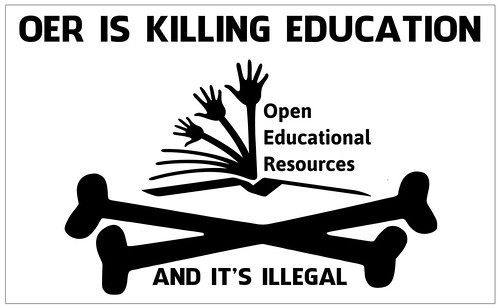
OER is killing education shared CC by empeiria

I note that some kind of re-alignment of focus seems to already be underway. In 2015, we hear less about Open Educational Resources as a goal, and more about supporting open educational practice. I see that while the URL and hashtag of the conference remains “OER15” the opening sentence on the conference website describes the event as this year’s “Open Education Conference (OER15)”. And what once was the OpenCourseWare Consortium’s annual conference is now called the “Open Education Global Conference”. And the consortium itself has rebranded itself as the Open Education Consortium. (I hasten to add there is also that other Open Education Conference, which is back in Van Rock City this year.)

So I end my response to Sheila’s query with a question of my own. Would the cause of open be better served if we go further in this direction, and stop talking about “open” as a goal and instead focus on using it as a tactic to support allies who care about authentic, engaged, accessible, sustainable, and relevant public education?

UBC’s Policy 81: draft of a revision


Screen Shot 2015-03-14 at 4.40.45 PM

Screen shot of top of revised Policy 81, available here.

Around this time last year, the University of British Columbia implemented a policy called Policy 81, which mandated that any time a faculty member shared teaching materials with others, any other faculty member at UBC could use them for for-credit courses. The text of the current policy, not the revised one, can be found here. However, this link may change to the new policy once a revised version is passed; description of the old policy and my thoughts about it can be found in the blog posts below:

A blog post explaining the basics of the policy

A post discussing my fears of how it might affect faculty attitudes towards sharing their teaching materials openly

Slides and notes from my presentation at the Open Education 2015 conference on this policy


Revised draft policy

In February 2015, about a year after the initial policy was passed by the UBC Board of Governors, a revised version was put forward for comment. You can see the text of that revised version here (note, this is just a draft policy for comment–it has not been passed!). Here are the most important aspects, to my mind.

  • section 2.3: “UBC Scholars own all the intellectual property in the Teaching Materials that they create but, in order to facilitate ongoing use and collaboration where they have contributed those Teaching Materials to a resource for the collective use of their Department, School, or other academic unit or where UBC has made a material investment in the development of the Teaching Materials, UBC has the irrevocable right to use and revise those Teaching Materials in UBC credit courses and to share those rights within the community of UBC Scholars.”
  • Section 2.4: “For clarity, resources for collective use are repositories that exist independent from course delivery platforms such as Connect or individual course webpages.”
  • Section 2.5: “… a material investment in the development of Teaching Materials involves the provision of compensation, facilities, equipment or other resources beyond those ordinarily provided to all UBC instructors in the course of their normal duties, such as, for example, a direct discretionary investment in the development of Teaching Materials.”

Examples of “material investment” listed on the revised policy include receiving a course release to develop new teaching materials, receiving specific payments from the university to develop teaching materials, receiving TA or RA support specifically to develop teaching materials. It does not include having TA support in regular teaching of courses, receiving salary during study leave (even if one develops teaching materials during that time), “incidental use” of UBC computer equipment, or getting one’s usual salary and benefits.

So what would count under this policy, besides getting a course release or having TA or RA help to develop course materias? I’m guessing, maybe, getting a grant to develop certain teaching materials? Maybe if one gets a grant under UBC’s Teaching and Learning Enhancement Fund, perhaps, if that involves (as it often does) developing teaching materials?

At any rate, this is a much restricted version of the current policy, which says that whenever one shares teaching materials with someone else–it is notoriously unclear in what “sharing” consists–then UBC can use those materials in for-credit courses. Now, it’s only if one deposits them in a collective resource within their department, school, etc., or of UBC has made a “material investment” in them beyond one’s usual salary and benefits. It’s helpful that they’ve now clarified, in section 2.4, that posting one’s teaching materials to a Learning Management System or a course website doesn’t count–that was one question numerous people had about the current policy, namely whether “sharing” includes posting in such places.

Reaction from others

I haven’t heard much of anything around campus about this proposed revision. There doesn’t seem to be much of an uproar about it, which is not surprising because it is so much more restricted.

Still, the faculty union has expressed some questions and concerns. I mention just some of those, below, for the sake of this not being too terribly long. Many of their questions and concerns sound quite reasonable to me.

  • The Faculty Association letter (linked to above) states that they understood, through discussions with the university, that this would be an “opt-in” policy, and they would like that clarified:  “we recommend that the words ‘and have expressly agreed to share their intellectual property rights’ be added following the words ‘…or other academic unit’ in clause 2.3.” The idea here is to introduce “transaction points” where faculty members would be made clearly aware that their work will fall under the policy.
    • This is an interesting point because reading the revised policy as worded does not suggest any “opt-in” aspect. I would have had no idea that that was part of the discussion. I’m curious to see what the wording is when the policy is passed, because I get the impression from the current revised wording that it is not an opt-in policy, but happens automatically when one or more of the conditions are met.
    • I’m not sure what would happen at this sort of “transaction point.” Would the faculty member just be made aware that this would be a situation that would fall under the policy, and then they could decide to go ahead with receiving the “material investment” or not, and if they do, then that would constitute agreement to share intellectual property rights? I think maybe not, because of the next point (see below).
    • Is “shar[ing] intellectual property rights” the right language? I think it’s clearer, because fairly commonly spoken of, to say that the faculty member retains IP but provides UBC with a “license” to use the materials in such and such a way.


  • Similarly, the Faculty Association notes in the letter linked above that the current policy allows faculty members to opt out, and not have their teaching materials be allowed to be used and revised by others at UBC, but this one does not. Will there be an opt-out possibility? [April 17, 2015:] I re-read the Faculty Association letter and realized I had made a mistake in interpreting it earlier. It actually says that in the earlier version, there was the possibility to specify limits on how one’s teaching materials could be used. I had forgotten that that was the case in the earlier policy. So the following bullet points actually don’t apply anymore. I leave them here just because the earlier version of this post had them, in case anyone returns later.

    • Also interesting. I wonder if the opt-out possibility in the earlier version is because it had such a wider scope than this one, but maybe they aren’t going to allow opting out for this restricted version? Since the earlier version gave the opt-out option only if UBC did not provide a “material investment” beyond one’s usual salary and duties to develop the teaching materials, and only if one did not deposit those in a collection in one’s department, school, etc., then I bet they are not thinking of an opt-out option for this one.
    • Plus, if this one will be opt-in, as under number 1, then an option for opting out would not be needed, right? Or is it that #1 just asks that faculty be made aware when their work will fall under the policy, not that it will only do so if they agree to allow the university to use their teaching materials under the policy?
    • Perhaps the Faculty Association would like to see a “transaction point” before any work falls under the policy, in which the faculty member would be made aware that their work would fall under the policy, and then they have to decide specifically yes or no, whether they would like to share their work in this way (even while still receiving the “material investment”). That way, they could either opt in or opt out. But that doesn’t seem to need a policy…couldn’t we just have an opt-in system where people could share their teaching materials if they want to and not if they don’t? Does that need a policy, if it’s completely voluntary? I’m not sure, but I would guess not. And I’m guessing that such a voluntary opt-in system is not what the Board of Governors is looking for.


  • The Faculty Association says in their letter that they would like to see more clarity on what “material investment” means, and specifically, to call it “extraordinary material investment” instead, to point to the difference between investment in one’s normal work and investment beyond that.
    • I think the change to “extraordinary material investment” makes sense.
    • The FA also points out that it’s fairly common in departments to give faculty members course releases to create teaching materials (which is news to me, actually). They are claiming that this is part of a faculty member’s “regular duties” because it is a common practice (I think that’s the point). I think what they’re getting to here is that they don’t want this to be part of the policy automatically, but it would be discussed at some “transaction point” and both the university and the faculty member would then agree that it falls under the policy. But see my above questions about what would actually happen at those transaction points–would one be able to receive the “material investment” while also opting out of giving UBC permission to reuse and revise the materials?


  • The Faculty Association letter notes that the policy is silent on attribution: will those whose materials are revised or reused need to be attributed? The previous version of the policy did include provisions for that (unless one says one doesn’t want to be attributed).


  • [New as of April 17, 2015:] The Faculty Association wonders in their letter about the definition of “UBC Scholars” in the policy, because it allows all UBC Scholars to reuse and revise teaching materials that fall under the policy. Section 2.1 states, for example: “UBC wishes to enable the members of its community who teach or participate in courses of study at UBC (“UBC Scholars”) to collaborate in the development of materials used in association with those courses.” As the Faculty Association notes, this seems to imply that “the entire student body of the university” would be able to reuse and revise teaching materials that the policy applies to. The FA letter states that this is too wide an audience: “We do not believe that the University intends to be so expansive, but the current wording could produce such an outcome.”
    • I have no idea what the University intends by defining “UBC Scholars” in this expansive fashion. In the previous version of the policy it was explicitly stated that the rights to reuse and revise teaching materials lay only with “UBC Instructors.” This draft quite clearly indicates that anyone who participates in courses of study (e.g., students in for-credit courses, but perhaps also in not-for-credit courses?) would also have such rights.
    • On one level, I actually think of this in a kind of positive light: I think that it could be fantastic for instructors to make some of their teaching materials available for students to revise. It could be a great learning experience for them. On the other hand, though, sharing teaching materials with students and allowing them to reuse and revise them should be an individual choice of faculty members, in my view.
    • A couple of colleagues have brought to my attention that students are uploading their course materials into websites that sell them to others, or allow the materials to be viewed if a student uploads something else, all without the instructors’ permission. This sort of blanket statement about giving students the irrevocable right to reuse and revise would facilitate this sort of behaviour, because if the materials fell under the policy then the faculty member could not complain if this is what ended up happening to them.
      • Personally, of course, I share my teaching materials with a CC license, so students may do this with them. I don’t care so much except that others will think they need to pay for materials I am making freely available, or that they need to violate someone’s copyright to get a hold of them. That part I dislike.


Reaction from me

Well, I’m such an advocate for sharing one’s teaching materials openly–publicly, with an open license–that I don’t mind this policy at all. I think it is much less likely to lead people to not want to share their work openly than the last one did, given how much more restricted it is. As noted in the blog posts listed at the beginning of this one, a number of faculty members at UBC were very upset by the original policy, because it seemed to them as if UBC were trying to get their hands on teaching materials in order to use them to make money from courses without having to pay people to develop teaching materials (e.g., in online courses they offer for a fee).

I could be wrong, though; maybe even this restricted policy will lead to the same concerns. I just haven’t heard them yet.

As previously, my main concern with all this has been that it may have led people to be less likely to consider sharing their teaching materials publicly with an open license (such as a Creative Commons license). If they have become suspicious of UBC’s motives (which a small survey I did last Fall suggests some have–see my slides and notes from a presentation I did on this policy last Fall) and don’t want to share even with just UBC, then they aren’t going to be willing to share more widely (because then UBC could also use the materials).

Previous to all this, I thought it might have been a good idea to try for a policy that requires a Creative Commons license if one receives a grant to develop teaching materials, such as from the Teaching and Learning Enhancement Fund at UBC. The money for that grant comes from student fees, and it made sense to me to say that at least students should have access to those materials. Of course, one could give them access through a more restricted policy, and it’s interesting that the Faculty Association specifies in their response to the revised Policy 81, as noted above, that they would like to see it clarified so that it does not include students. But I’m now wondering if the right thing to do at the current time, at least here, wouldn’t be to just focus on efforts to encourage people to share their teaching materials openly on a purely voluntary basis. Any more attempts to make such things into a policy, right here and right now, are not likely to go over well.


What else might be done to increase open sharing of teaching materials?

It would be great if we could raise awareness and give support to people who would like to share their teaching materials openly and publicly–e.g., best practices on formats, where/how to share them, where/how to find those by others that one might use, etc. There’s a bit about open educational resources on the UBC Copyright website (but mostly it’s about how you can use such things under the auspices of copyright law). UBC also has quite a comprehensive and useful Guide to Creative Commons.

I wonder if we might do more beyond having these resources available. I’m trying to do a bit by holding workshops on open education here and there, but it is common that only those already interested in such issues attend.

What else might work to raise awareness and provide support? Assuming that the university would actually prioritize putting money towards this, what would be some good things to do beyond a policy that requires sharing in some form? I’m curious if anyone has any thoughts.


Photos for Class provides safe search and auto-attribute for Flickr images

Came across a site that may be a good one for k12 teachers looking for a way to safely search Flickr for Creative Commons material, and for anyone looking for an easy way to attribute Flickr photos.

Photos for Class is a site that uses a combination of Flickr’s Safe Search filter and a few in house filters and allow you to search Flickr for G rated CC licensed photos. Which is useful in itself, especially if you are in a k12 environment. But the bit that everyone will find useful about Photo for Class is that when you download the photo, the CC attribution is automatically added to the image using the CC recommend TASL (Title, Artist, Source, License) format for correct attributions. Which works great if you are simply wanting to find and use an image without modifying it.

I did a quick search for the phrase totem pole and came up with a number of images.With each image there is an option to download, view on Flickr or report (if an inappropriate image has slipped through the filtering process, there is community moderation). I downloaded the first result and got this photo with the attribution automatically added at the bottom of the photo.

7975351242

One of the things I hear often from people new to Creative Commons licenses is how to attribute resources. Here is a nice tool that makes it very easy to find and correctly attribute a CC licensed photo on Flickr. There are other tools, like the OpenAttribute browser plugin, the Washington State Open Attribution Builder and Alan Levine’s Flickr specific attribution bookmarklet also available to help make it easier to attribute CC resources correctly.

h/t to Dr. Jo Badge blog post on teaching children about Creative Commons licenses.

Some Quick Numbers on WordPress & MediaWiki at UBC

The three main platforms that support open education at UBC are UBC Blogs (WordPress), UBC Wiki (MediaWiki), and UBC CMS (WordPress). They are used in a lot of different ways but on the start of Open Education Week, I thought I’d post some quick stats Scott helped me pull for a recent presentation. All numbers are current to the beginning of March.

UBC Blogs

  • unique users: 28,777
  • unique blogs: 21,207

UBC Wiki

  • unique users: 16,658
  • pages/files: 56,436

UBC CMS

Since September 2014, there have been almost 10,000 new users across the platforms. The team that helps develop these platforms not only do a fantastic job supporting set of a robust, always up tools that underpin a lot of UBC’s open education efforts but they are also involved in numerous innovative projects that push our understanding of how these technologies support teaching and learning, such as UBC’s Open Badge Pilot.

Need a damn computer to keep track of all these open events *

Whirl Wind

Whirl Wind by Jonathan Trumbull used under CC-BY license


There are a slew of Open Education events on my radar/ToDo list right now.

Open Education Week

Next week is the global Open Education Week from the Open Education Consortium. There are events happening around the world for this week, both live and online (full schedule of global events). BCcampus is participating by sponsoring a week of Open Webinars on Open Education. These are (as you might have guessed) free and open for anyone to attend, and I am very grateful to all of the presenters who have agreed to participate, from Camousn College, UBC, TRU, UVic, KPU and the OER Research Hub, as well as my colleagues from BCcampus.

Full schedule & connection details for  our Open Webinars on Open Education next week (March 9-13).

The BC Open textbook Summit

The 3rd annual Open Textbook Summit is happening May 28 & 29 in Vancouver. My colleague Amanda Coolidge is putting this event together & we are looking  for presentation proposals. We’ve had a number of great proposals already submitted that have me excited. If you have been working on an open textbook project, the call for proposals runs until March 23rd. Consider submitting and joining us.

BCcampus Faculty Fellow and open textbook advocate Dr. Rajiv Jhangiani from KPU (fresh back from his dream vacation to New Zealand for the Cricket World Cup) is our opening keynote. Rajiv has become a real force in the open textbook world and has made incredible progress in both his discipline Psychology and at his institution advocating for wider use of open textbooks. He was our first “free range” adapter (leading me to do a happy dance) and has been actively using open textbooks as an instructor in a number of courses.

The second keynote for the summit is one that I think is a stroke of brilliance from Amanda as it is being done by three students who have been leaders in the open textbook movement in Western Canada. Chardaye Bueckert from Simon Fraser University, Max Fineday from University of Saskatchewan, and Erik Queenan from Mount Royal University. Max is a wonderful speaker, Chardaye has been a long time supporter and advocate, and Erik has been doing some very interesting work on the ground. I am really looking forward to their talk.

Registration is now open.

OpenEd 2015

Working with David Wiley from Lumen Learning on this one. The annual OpenEd conference is happening November 18-20 in Vancouver, and David has just released the call for proposals for that. Last year was my first OpenEd in Washington. I did attend briefly in 2012 when it was in Vancouver, but was sequestered away shortly after Gardner Campbell’s excellent morning keynote (go watch it) for a BC specific open education meeting hot on the heels of the announcement of the BC Open Textbook Project, so didn’t really experience OpenEd as I had hoped.

My first task was securing a location for the event in Vancouver – no easy task considering the event has grown and last year was over 500 attendees. We’re used to doing events at BCcampus, but nothing at that scale (although David assures me that it will likely be a more modest affair this time around). At any rate, trying to find a venue in Vancouver was a challenge, but we think we have found a good one in the historic Fairmont Hotel Vancouver that will give the conference a very west coast feel.

OEC’s Open Education Global

Finally, in April there is the OEC’s Open Education Global Conference in Banff. I’ll be attending and meeting others from the global open community. Being peripherally involved with the Mozilla community here in Victoria (never as much as I would like these days), I am especially jazzed to see & hopefully meet Mark Surman from Mozilla. Mark is doing one of the conference keynotes. Mozilla is heavily invested in lifelong learning with initiatives like Webmaker and OpenBadges,  and everyday I appreciate more and more the work Mozilla does advocating for an open web and empowering people – especially kids – to tinker, make and (most critically) understand how the open web works and why the open bit is fundamentally important to the future digital world they are/will live in.

* apologies Lou